

Where I Come From: The 250-Year Story Behind My Name
What follows is a historically grounded narrative based on my family tree, the documented history of the Bruce-Vanderpuije family, and the known history of the Dutch Gold Coast. Some details are well documented. Others are informed reconstruction, where the records run thin. I have tried to be honest about which is which.
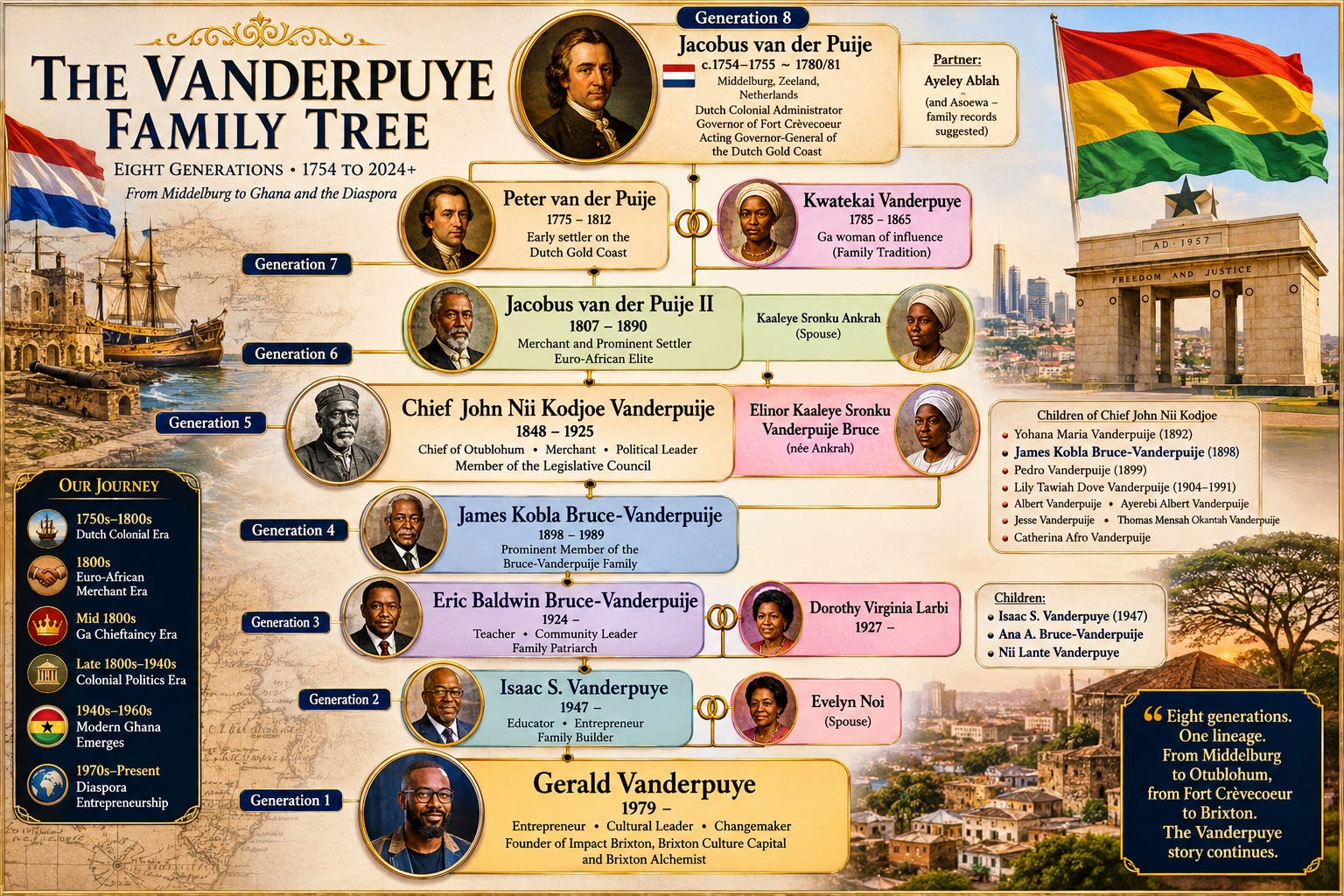
I have always wondered where my history was.
The name was a clue I carried my whole life. Vanderpuye is not a Ga name. I always knew there was a Dutch thread somewhere. But knowing a name points across the sea is not the same as knowing how it got to you.
So I went looking. I spoke to my dad. I used Ancestry and 23andMe. This is what the digging gave me back.
The world the name came from
To understand why the Vanderpuye family exists in Ghana, you have to go back to the late 1700s.
Back then, the coastline of modern Ghana was one of the most important places in the world.
Europeans called it the Gold Coast.
The Dutch, British, Danes, Portuguese, Swedes and Brandenburgers all fought for influence there.
Along the shore stood massive forts:
Elmina Castle
Fort Crèvecoeur
Cape Coast Castle
Gold flowed through these forts.
So did people.
And tragically, so did enslaved Africans.
My family story begins at the intersection of all three.
Jacobus arrives from the Netherlands
Around 1754, a boy named Jacobus van der Puije was born in the Dutch province of Zeeland.
His family came originally from a small town called Sint-Maartensdijk, and his father is recorded as William van der Puije.
Like many ambitious young Dutchmen with few prospects at home, Jacobus entered the service of the Dutch West India Company.
At the time, this was one of the most powerful corporations on earth. I think of it as a combination of:
a government
a military
a trading company
a shipping empire
all rolled into one.
As a young man, Jacobus was sent thousands of miles from Europe to the Dutch Gold Coast.
He did not arrive as a settler looking for land.
He arrived as a colonial administrator.
And he rose fast. By 1776, still in his twenties, h
e was governor of Fort Crèvecoeur at Accra. By 1780 he had become Acting Governor-General of the entire Dutch Gold Coast.
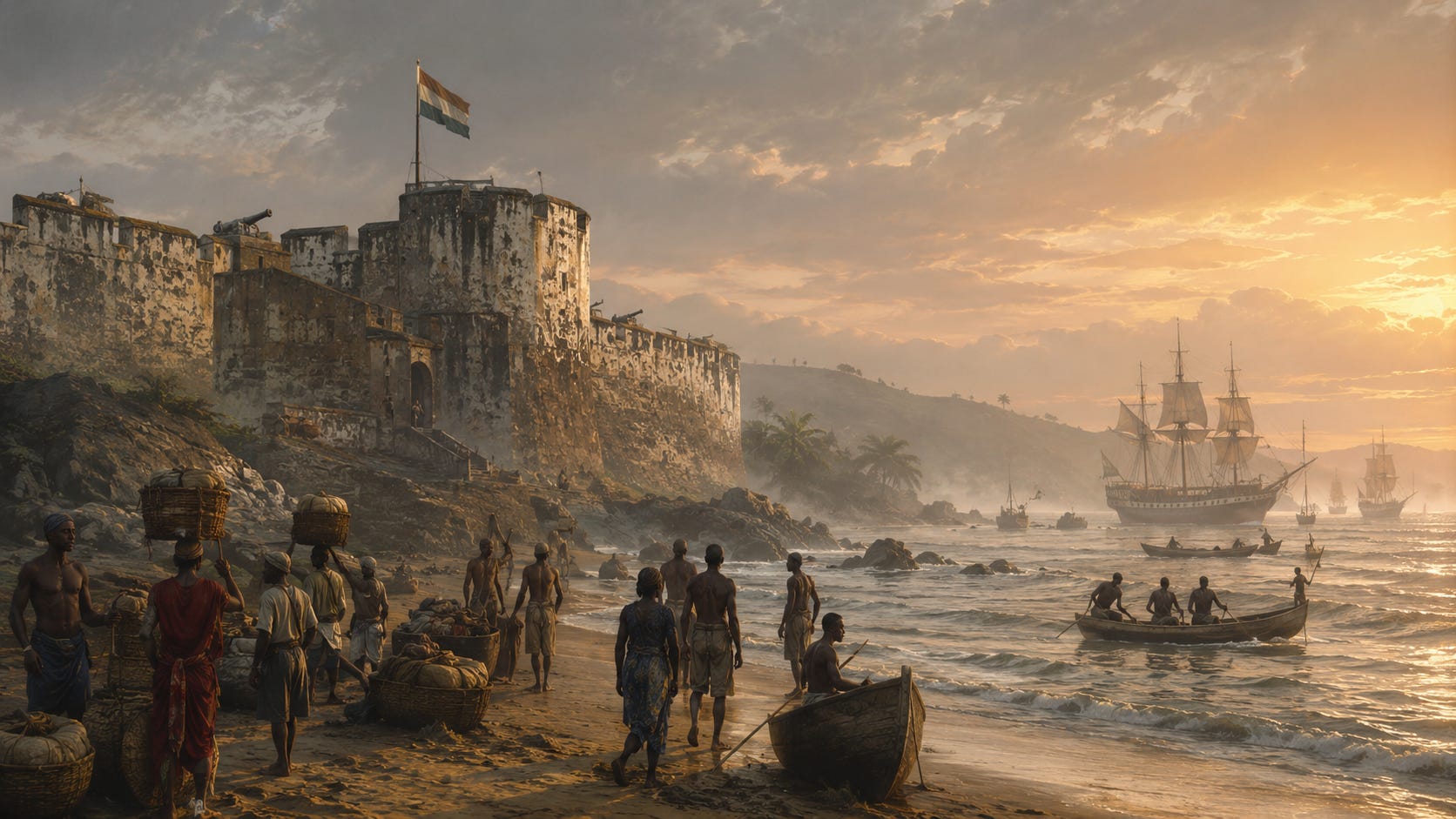
In modern terms, he was effectively running the Dutch colonial territory in what is now Ghana.
He was about twenty-six.
The part most families skip
This is where my story becomes complicated.
Many family histories try to avoid this part. But it is impossible to understand mine without it.
The Dutch Gold Coast was deeply entangled with the Atlantic slave trade.
The forts that men like Jacobus administered existed for a mix of reasons:
gold trading
military alliances
colonial administration
the buying and selling of enslaved Africans
Jacobus was not merely living near this system.
He was one of the senior officials administering the colony while it operated.
I won’t hide behind “he was only an administrator.” Administration is exactly how that trade was run.
And the records make it personal. One of Jacobus’s children was born to an enslaved African woman named Asoewa. Their daughter, Anna, was born enslaved too — and freed for the price of one mark of gold.
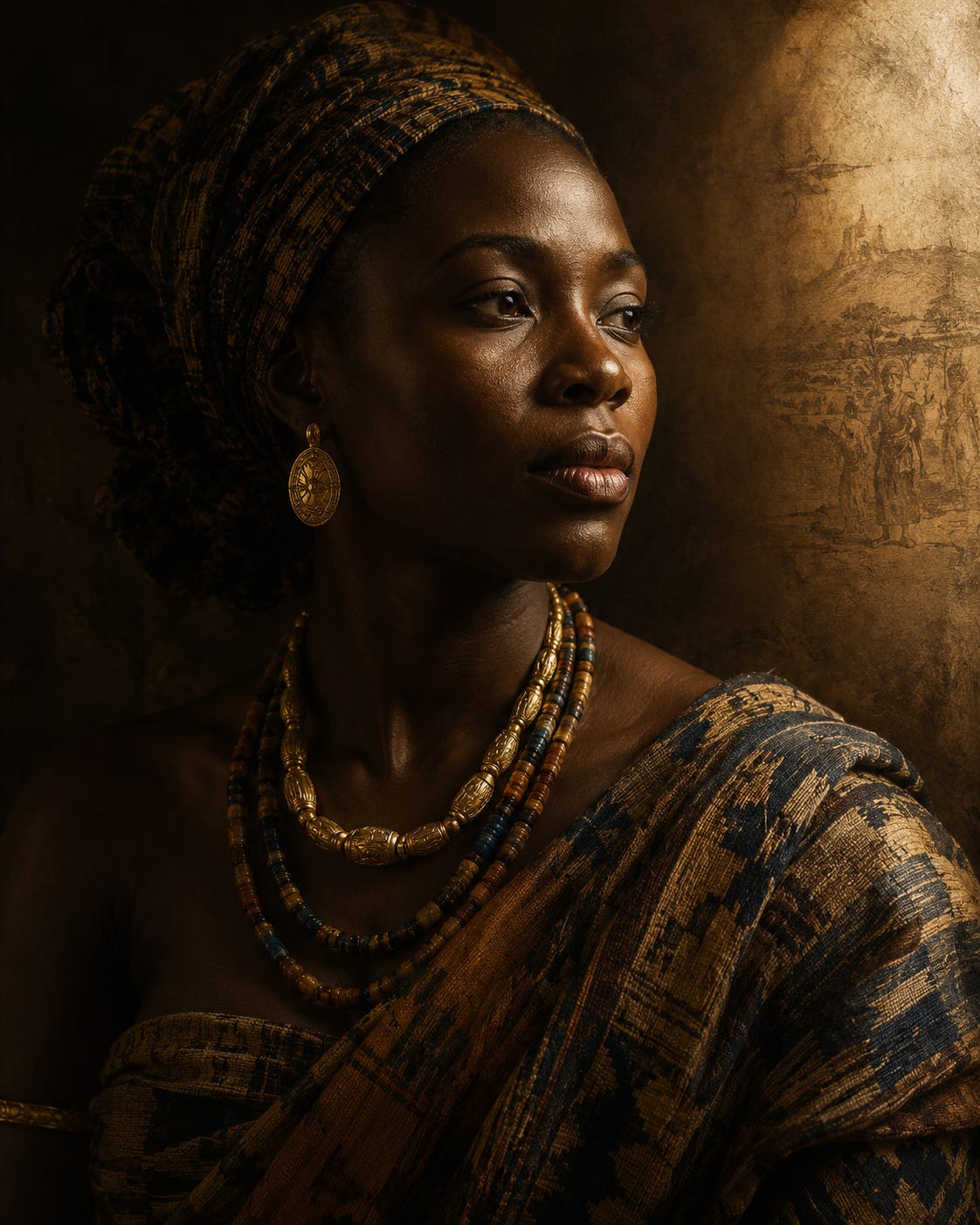
Another of his children was born to a Ga woman of Accra named Ayeley Ablah.
So within my own bloodline there are, at the same time:
a European colonial administrator
African women living under colonial rule
and, in Asoewa, a woman who was herself enslaved
That reality is uncomfortable.
But it is also the truth of many Afro-European families on the Gold Coast.
My family story is therefore not simply a Dutch story.
Nor is it simply a Ghanaian story.
It is a story born from one of the most morally complex periods in human history.
Peter — the first of us born in Africa
Around 1775, Jacobus’s son Peter was born in Ghana, to Ayeley Ablah.
Unlike his father, Peter was African-born.
Unlike his father, Ghana was his home.
Peter grew up between worlds. He inherited:
a Dutch surname
European connections
African ancestry
ties to Ga society
His generation became part of a new class often called the Euro-Africans.
These families became enormously influential along coastal Ghana. They worked as:
merchants
translators
diplomats
intermediaries
between Europeans and African kingdoms.
Peter is the moment my family stopped being Dutch visitors and started becoming Ghanaian.
Becoming Ga
Over the next few generations, something remarkable happened.
The family became more and more woven into Ga society.
The Dutch bloodline remained.
The surname remained.
But culturally, the family became Accra.
Children married into local families. The Ankrah name appears again and again in my tree, alongside other prominent Ga lineages. The family became part of the social fabric of the city itself.
And the name itself evolved:
Van der Puije → Vanderpuije → Vanderpuye.
The spelling stayed European.
The identity became Ghanaian.
I want to be clear about how that happened, because it matters. The Ga pass important rights through the mother’s line. So the family’s standing in Accra — its place, its belonging, eventually its right to a stool — did not come down from the Dutchman.
It came through the women who married into it.
Chief John Nii Kodjoe Vanderpuije
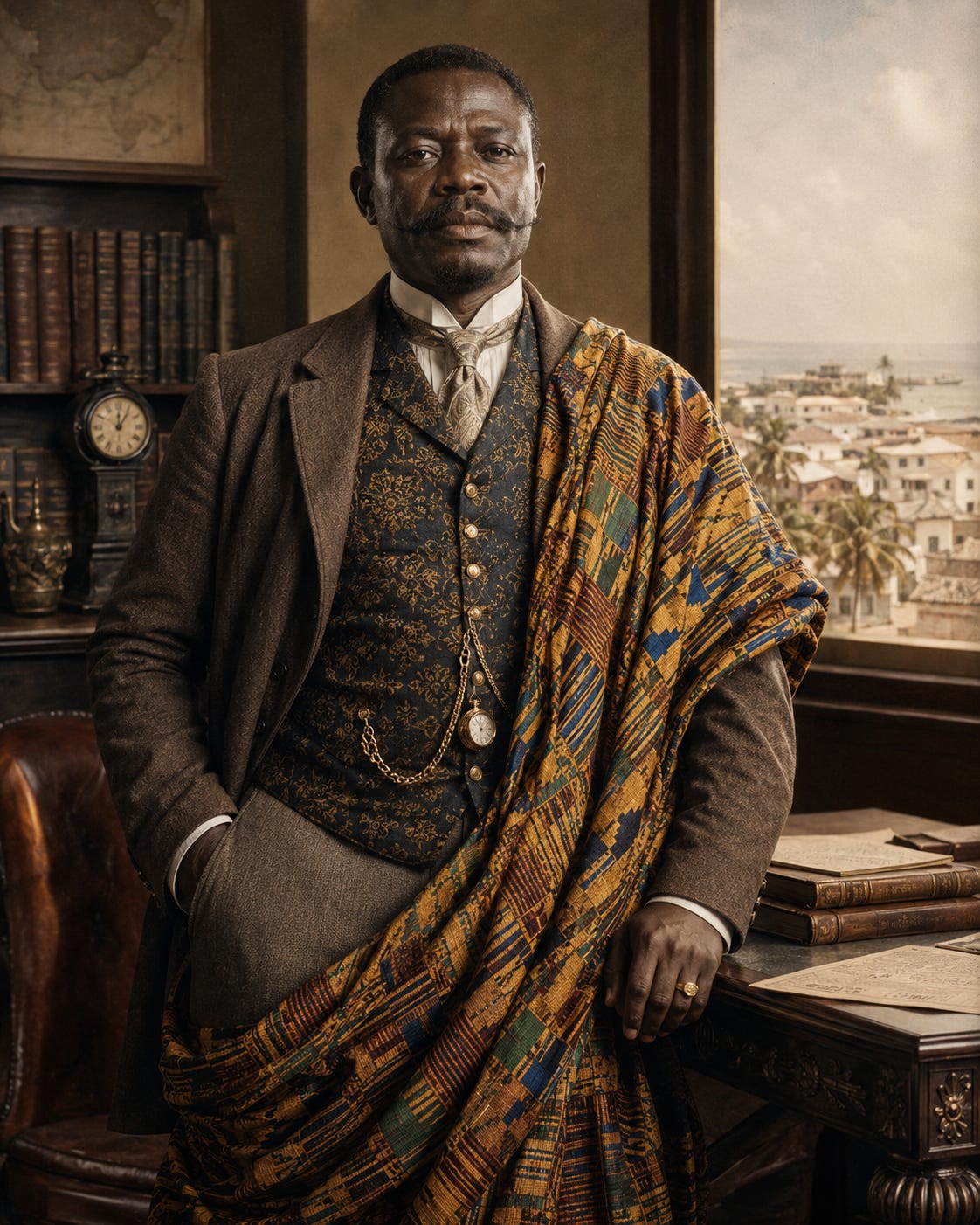
By the mid-1800s the family had transformed completely.
Then came one of the most important figures in our whole history:
John van der Puije. Born 1848.
Unlike Jacobus, he was not a colonial governor.
He was a Ghanaian leader.
A merchant. A chief. A politician. A public figure.
His mother was Naa Karley Ankrah, of the royal house of Otublohum — one of the old ruling families of Accra. And that is why he could become a chief at all: not through his Dutch surname, but through his mother’s royal blood, by Ga custom.
He made the most of it:
He traded in cocoa, the crop about to make the Gold Coast Britain’s richest West African colony.
In 1880 he helped found the Gold Coast Chronicle, one of the first African-owned newspapers.
In 1888 he was enstooled chief of Otublohum.
In 1894 he was appointed to the Legislative Council of the Gold Coast.
His finest hour came in 1897, when the colonial government tried to pass a Lands Bill that would have let the Crown seize land held under indigenous tenure. John fought it from inside the Council. His newspaper fought it in print. A delegation went all the way to London.
The bill was withdrawn.
It is remembered as one of the first great victories of organised African resistance on the coast.
By this point my family was no longer being shaped by Europe.
It was helping shape Ghana.
The descendants of a Dutch governor and a line of Ga women had become leaders of Accra itself.
That is one of the most fascinating transformations I have ever read about — and it is mine.
The Bruce connection
The next major chapter is the rise of the Bruce-Vanderpuije branch.
Through marriage — again, through a woman of the Otublohum royal house — the family joined with another prominent coastal family, the Bruces.
The result is the name that runs into my own direct line: Bruce-Vanderpuije.
This branch produced James Kobla Bruce-Vanderpuije, who in 1922 founded the Deo Gratias photo studio in Jamestown — now the oldest operating photography studio in West Africa, holding an archive of some 50,000 images of Ghana, and still run by our family today.
Then Eric Baldwin Bruce-Vanderpuije, the generation that lived through independence in 1957.
Then Isaac Vanderpuye — my father, born in 1947, a boy of ten when Ghana became free.
And then me.
Gerald Vanderpuye
I am roughly seven generations removed from Jacobus.
Which means my ancestry holds, all flowing into one line:
Dutch colonial administrators
Ga women
merchants
chiefs
politicians
entrepreneurs
cultural leaders
My family’s journey mirrors Ghana’s journey:
Dutch colonial period ↓ Slave trade era ↓ Euro-African merchant class ↓ Ga chieftaincy ↓ Colonial politics ↓ Modern Ghana ↓ Diaspora entrepreneurship
And in many ways my own work sits on the far end of that same arc. Impact Brixton, Brixton Culture Capital, my pull back toward Ghana — they all live at the intersection of:
commerce
community
culture
identity
the same four forces that have shaped this family for over 250 years.
The questions I’m still chasing
The honest end of any search is a list of what it still doesn’t know. Mine has four big ones.
1. Was William van der Puije really Jacobus’s father? My tree shows William. I haven’t yet seen primary documentation proving that link. It needs verification in the Zeeland records.
2. Did Jacobus die at sea, or in Ghana? My family always said he died at sea, sailing home to Holland. The historical record says he died on the Gold Coast in 1781, and never left. I lean toward the record — but I want to settle it properly.
3. Who exactly was Ayeley Ablah? This may be the most important missing piece of all. I know a great deal about Jacobus. I know almost nothing about the African woman who gave birth to Peter. And genetically, she contributes every bit as much to me as he does.
4. Was the family enslaver, enslaved, or both? Given the period, the line may include people on both sides of that history. That deserves careful investigation, not assumption.
Here is what I’ve landed on.
The most powerful version of my family’s story is not:
“A Dutch governor came to Ghana.”
It is:
“A family emerged from the collision of Europe, Africa, empire, trade, slavery, resistance, and Accra itself. Over 250 years, they went from colonial outsiders to one of the city’s established Ghanaian families.”
That story is far richer — and far more human — than the simplified legend most families inherit.
I went looking for where my history was.
It turns out it was never really in Holland.
It was in Accra the whole time.
If you’re family and you remember any of this differently — a name, a date, a story you were told — please tell me. The next thing I want to do is sit down with my dad’s generation and record everything they remember, while they’re still here to remember it. That’s the part no archive can give back.
Gerald@hey.com